
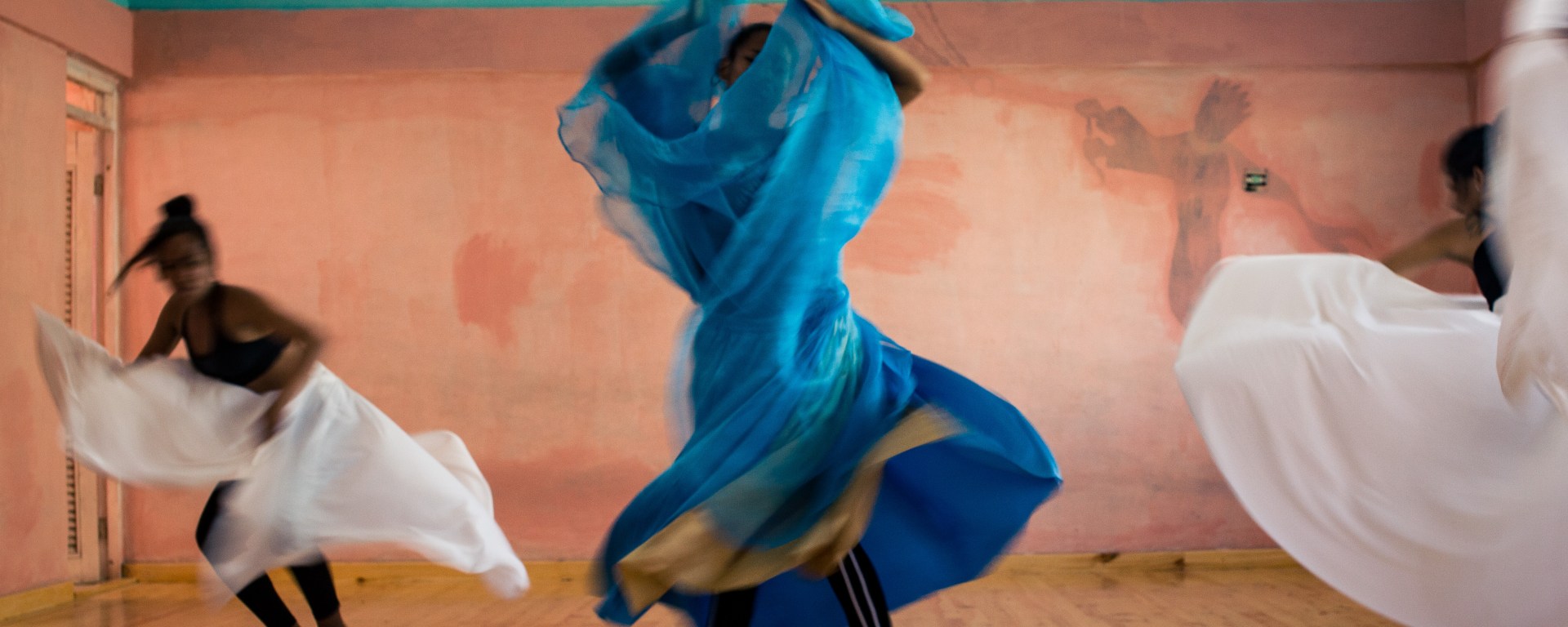
“After I had my two children, I thought I would never dance professionally again” said Mercedes Salazar “I thought I was going to have to become a bank employee or take an office job….” her reserved husky voice hinting at maturity beyond her 21 years.
We sat in a shady courtyard among the low-rise concrete dormitories of Cuba’s Korimakao Art Commune. Our conversation was overlayed with the spine-tingling rhythms of live Cuban Jazz broadcasting the concentrated essence of Cuban history into the wetlands of the surrounding Cienaga Zapata National Park.
The song – Azowano by Havana D’primeira and Alexander Abreu – tells the story of Babalu-Aye, a deity of the Yoruba religion of West Africa and his triumph over sickness and vice towards triumph. Guided by the deities Eleggua, Changó, and Obatala, Babalu-Aye fulfilled his prophecy to become a healer and saviour.
“Azowano, Ashé mi Babalú
Here we Cubans are
asking you for health, health, (Cuba!) health.
People who fight
against wind and tide,
but we need a miracle my old man
that will cure our sick
all over the world and everywhere
My miraculous old man,
My divine Saint Lazarus,
Cuba comes to your corner
to seek your blessing”
The story bridges the suffering of those who arrived in Cuba as slaves and Cubans today, who, through a conflation of disasters and economic warfare, face limited food choices, shortages of imported equipment, transport, and medicine, and rapidly depreciating wages.
In the midst of the Covid-19 pandemic – which deprived Cuba of vital tourism income – the United States tightened its 60-year sanctions regime against Cuba by labelling the country a state sponsor of terrorism. This deprived Cuba of the ability to import sufficient medical equipment to vaccinate and treat its population – despite being the only poor country to develop multiple effective vaccines.
US-imposed financial sanctions against Cuba are so tight that in December 2022, I – an Australian citizen residing in Europe – had my bank accounts sanctioned and frozen for transferring Euros between two European bank accounts. I had simply given the transfer reference as ‘Alex Cuba’.
The 2020 pandemic also coincided with the Cuban government’s economic adjustments, which allow vastly more opportunities for Cubans to engage in private enterprise. They have also influence currency devaluation and emerging income inequality.
Conditions have been described as the country’s toughest since the ‘special period’ of the 1990s. When I arrived, increasing poverty was driving tens of thousands of mostly young people to leave the country every year. The typical U.S. strategy – impoverishing the populations of disobedient nations until they overthrow the government or leave the country – is at least partly working in Cuba.
Yet despite the world’s longest-running blockade, Cuban society has remained cohesive and largely tranquil through extreme challenges and hardship. Some of the reasons why can be seen in Korimakao.
Based in Cuba’s least populated and least developed municipality, Korimakao was the result of a chance meeting of two influential men during the dire shortages resulting from the collapse of trade with the Soviet Union in the early 1990s. One was well-known Cuban actor Manuel Porto, who was filming a series set in the Cienaga Zapata national park. The other was Faustino Perez, a commanding officer of the revolution, who oversaw the integral development of the Zapata Swamp area.
Cuban revolutionaries including Pérez believed that art could not be overlooked as part of a community’s development and expression. The result of Perez and Porto’s vision was Korimakao – an institution devoted to nurturing and sheltering the talent of the Cienaga Zapata community in dance, theatre, music, and visual arts. I met Mercedes through a five-day visit to Korimakao in January 2023.
“You know, people know me here as very happy person, always smiling and open. But before I arrived dance was my only opportunity to express myself – to disconnect from problems in daily life – and then I would return to being timid,” she said.
Mercedes had spent the morning training me for a Salsa performance that evening, and while content with the buzz of dance, we were caked in dust and sweat there would not be any running water to shower with until the two-hour window from 5.30-7.30pm.
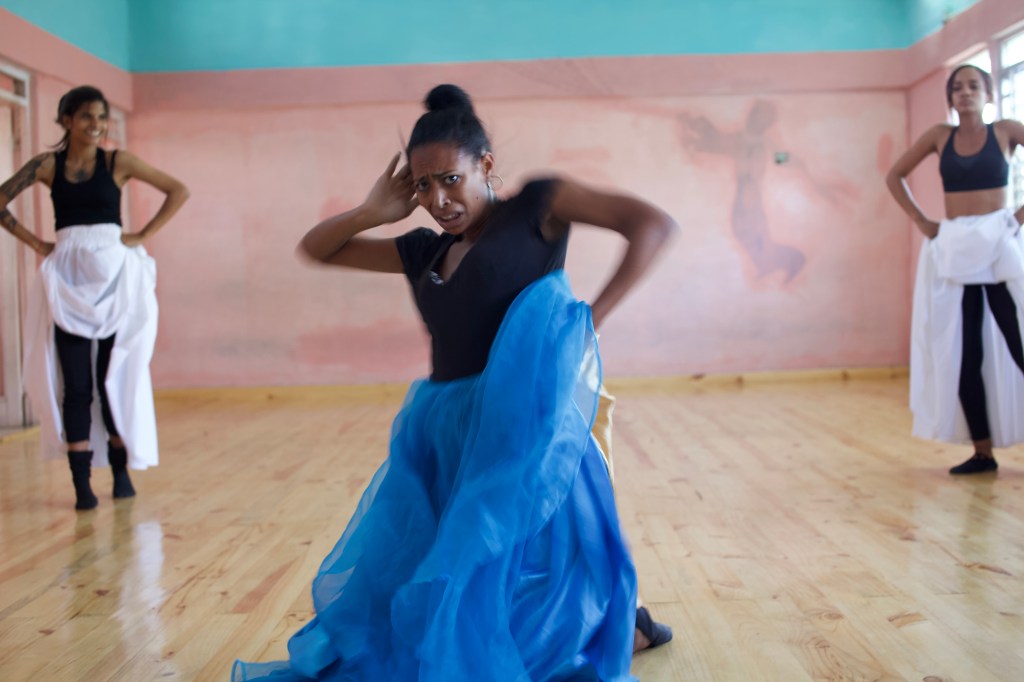
After showering, Mercedes and her colleagues – all professional artists in training – would sit down to a predictable meal of vegetable soup, rice, black beans, and when available, fish, pork, or eggs.
The artists would then sleep in six-bed dormitories with no mosquito netting nor air conditioning, resting for the same the next day, and the next, until they were prepared for professional life.
“I’ve danced since I was three years old. All my life I wanted to become a professional dancer, but the opportunities are not common,” Mercedes said. “Of course, working for a travelling troupe or performing for tourists you can earn a lot more money than a standard Cuban wage. I used to earn 2000 Euro in three months in Europe, compared to $75 here.”
“Dancing and art are not just about the money you know, with all the domestic problems we have in Cuba, art has become a primary way for us to experience happiness within all the struggles.”

The morning after my clumsy but joyful Salsa show with Mercedes, I prepared to join the Korimakao dancers and theatre actors on a bus trip to see another side of their work.
“The name Korimakao is derived from Cuba’s indigenous Arawak language. In Arawak, ‘kori’ stands for human being, and ‘makao’ represents arthropods which live in shells, such as snails,” Artistic Director of Korimakao, Yander Roche told me over breakfast.
“The term was used by indigenous Cubans to define a nomadic lifestyle. It shapes the way we see our arts troupe, which features youth from all over Cuba providing artistic service to various community spaces, carrying along their art, identity, and vocation.”
The commune focuses on developing talent from underprivileged areas which lack cultural venues and opportunities. Though they train eight hours a day, the youth – mostly between 17 and 25 – are known as employees not students. They receive a Cuban government salary of around 3400 Cuban pesos per month – about $20 at the street market rate when I visited in January 2023. As a part of their work at the commune, Korimakao employees perform regularly in underprivileged communities and schools across Cuba, to inspire and give back the gift of culture and joy.
After an hour’s drive down a dirt road to the east of Playa Giron, we arrived at the coastal village of Guasasa. The town could be straight out of Ernest Hemingway’s The Old Man and The Sea. Children ran to greet us as the bus pulled into the town square and men and women heavily weathered by the sun casually peered out from their simple concrete homes shaded by the coastal forest. The sandy town square is flanked by a medical centre – the town’s only 2-level building – and a 15 metre-square concrete slab shaded by a wood and tin roof.
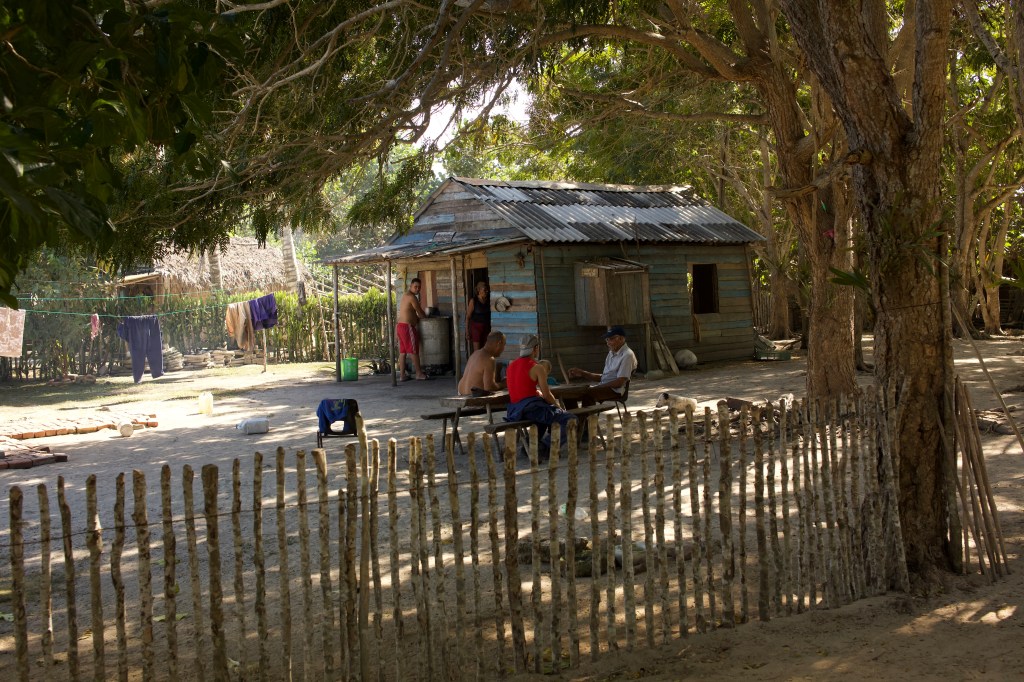
Three men riding into town on a horse and cart grinned at the out of place highway coach and the accumulating crowd of performers, children, and young parents. Most of the men had been working since the early morning. Their big hands were scarred from lives spent fishing at sea in wooden rowboats. As our group set up, they were already settling in to rest-away in the shade.
Forced from their morning grogginess by the glaring sun, the Korimakao performers split up. Theatre students went off to prepare their costumes and routine, and the others to prepare lunch, including gathering wood and charcoal to cook it on. While waiting I chatted to Marco, one of the dancers who had put on a magnificent ballet performance several days earlier. He had spent more time at Korimakao than any other dancer.
“When I was 14 I was having a lot of personal problems and dance helped me to alleviate them,” he told me. “I come from Pinar del Rio, from a rural area. The culture and mindset there still has a lot of discrimination against people like us.”
Now aged 21, the softly spoken Marco was referring to Cuba’s relationship to the LGBTI community. Less than a year earlier Cuba had passed Latin America’s most progressive family code. However, a legacy of discrimination against the LGBTI community remains.
“Part of my family was supportive, and part was not. Some of them thought I should do a real job. Something technical. I have received work offers already for dancing outside of Korimakao which pay better, but I declined them because I feel so comfortable here.”
“The community in Korimakao is much more accepting of LGBTI people and their rights than the Cuban community in general. I’ve been here for five years now. It’s like my second home and family now. It was a main reason why I stayed here, because here I learn and am treated like any other person,” he said.
Our conversation was cut short by the start of the performance. The crowd had grown to an assortment of 25 children, mothers, dogs, and young men passing by. For over an hour, five Korimakao actors enthralled and amused the people of Guasasa with pantomimes and short stories, using black wooden chairs as their only props.
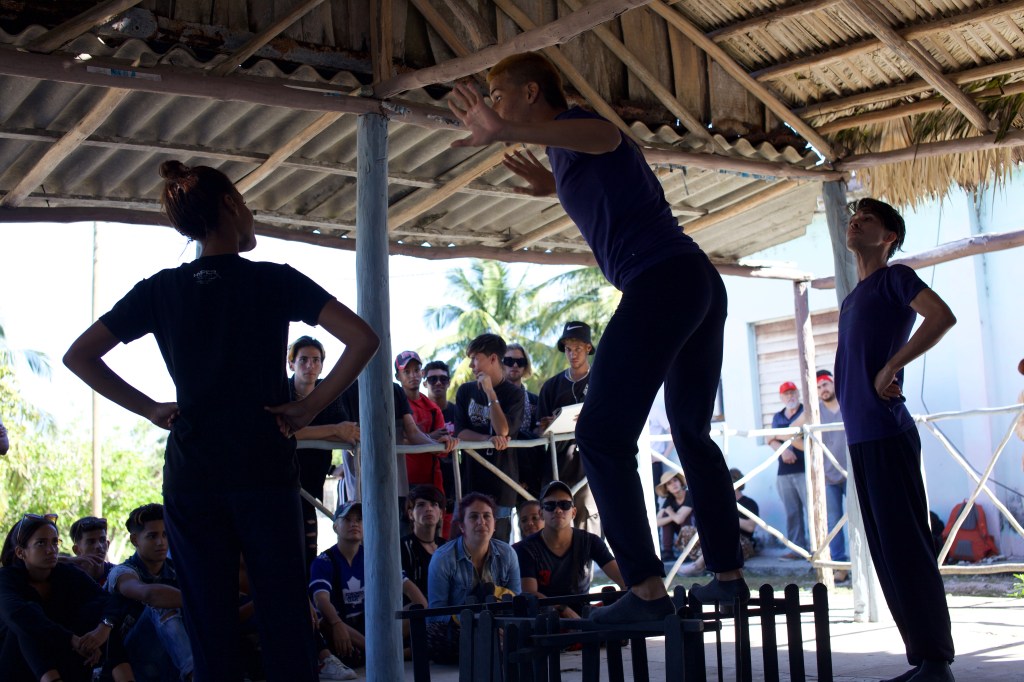
After several rounds of encores and a folk-dance circle with the children of the crowd, the boombox was packed away and the actors retired for lunch. No sooner was the concrete slab cleared of theatrics than another specialist team arrived – visiting nurses and dentists from the Playa Larga medical clinic.
The nurses set up a bare-bones clinic in the two-level building on the other side of the square and began extracting blood samples from the town’s adults. The dental team unfolded a reclining chair on the concrete slab and began calling for anyone with dental issues to come forward.
Using mobile phone flashlights, paper-wrapped pliers, and reusable steel syringes, three nurses performed minor surgeries and tooth extractions on several young men as their girlfriends and friends watched on, jesting at their winces and complaints.
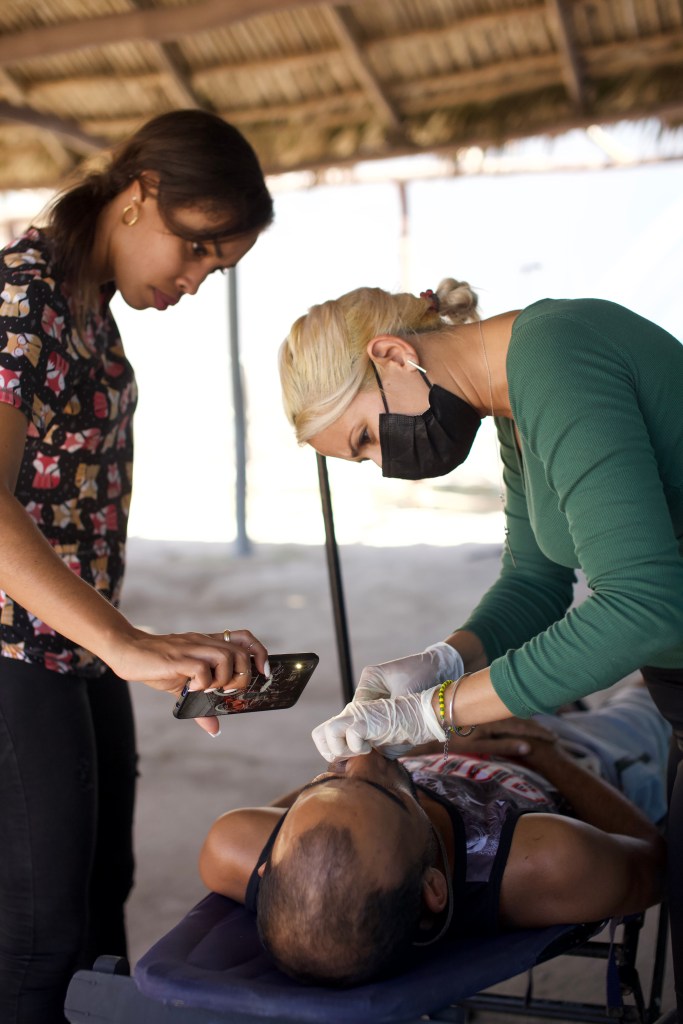
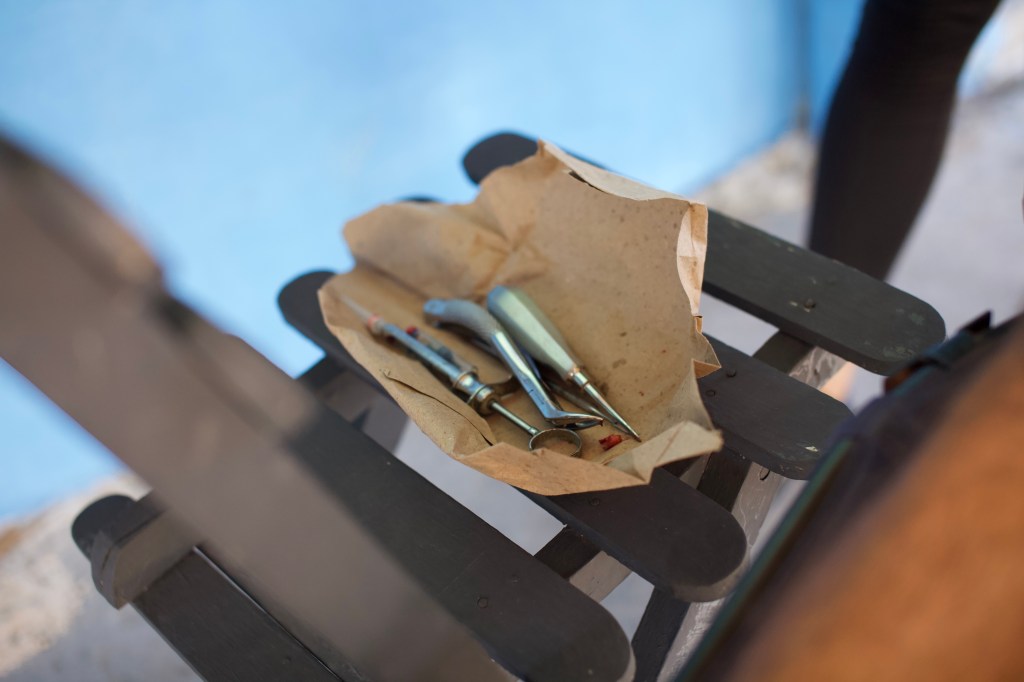
Mercedes joined me to watch the tragicomedy field-hospital. “You see the way Korimakao is dedicated to working in communities who do not have access to tourism income or services? It brings them a lot of joy.”
Echoes of the same spirit are found across Cuba. Several days later I sat in the theatre room of the El Mejunje cultural centre, just off the Spanish colonial town square in Santa Clara. With bare brick walls and repurposed church benches, rustic would be the best descriptor for the theatre if its appearance had been by choice. But in Cuba decay is an imposed reality.
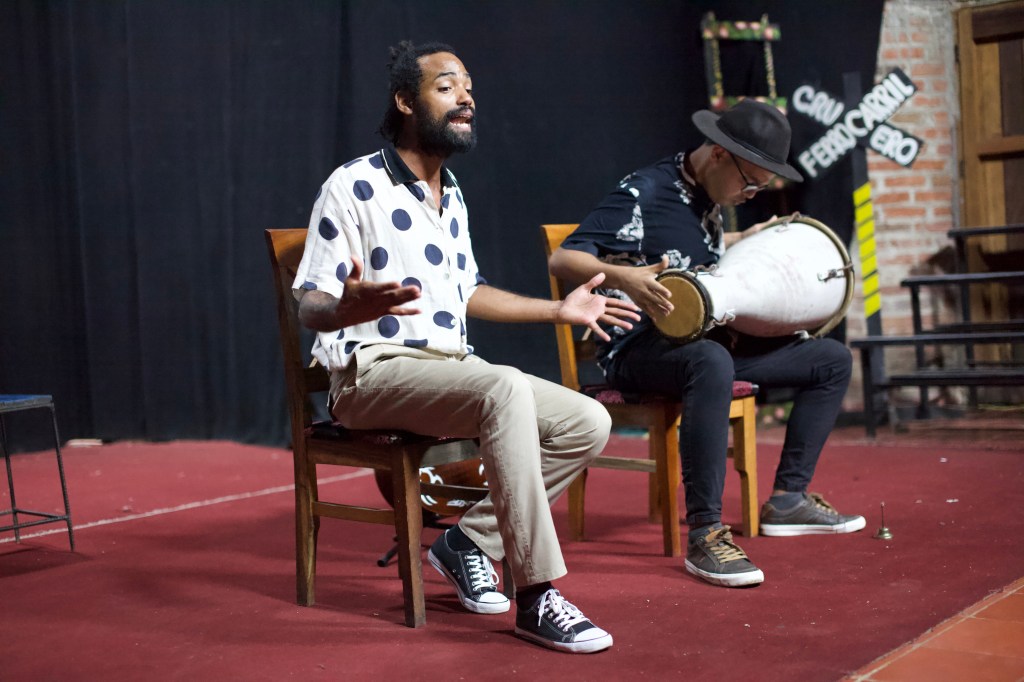
Two young men sitting on stools performed with only an acoustic guitar and set of bongo drums.
Coffee,
The night
A distant pain in the skin
Orishas,
The fire.
Ancestral seeds
Braids in the hair
We were born ‘black’ oh oh
We were born ‘black’
(Siá-cara!)
We were born ‘black’ oh oh
(The color of the sun)
We were born ‘black’ oh oh
We were born ‘black’
(Shekeré!)
We were born ‘black’ oh oh
(Owners of the Drum)
We were born ‘black’ oh oh
We were born ‘black’ ….”
(Ha ha ha)
We were born ‘black’ oh oh
Oh! What a bless!
…
José Luis Izquierdo Hernández (Luisiño) and Frank Abel García Falcón (Frank Falcón) – the Dúo Fábula – had travelled half the length of Cuba to play at El Mejunje. Their song ‘Color’ is but one more mesmerising Cuban ode linking Latin America to Africa across hundreds of years of trauma.
Frank and José’s voices competed with the soundcheck from the leafy courtyard next door, where preparations were underway for one of Cuba’s few drag shows.
El Mejunje – named after a term for a mixture of medicinal herbs – is known primarily as a cultural centre for Cuba’s LGBTI community but since opening in the late 80s has grown into a far larger symbol of communal solidarity in the face of hardship.
Shortly after El Mejunje opened in a long-abandoned colonial era hotel, Cuba’s trade lifeline with the Soviet Union collapsed leaving the Caribbean Island cut off from nearly all essential imports including fuel.
“The 90s were a very difficult time. We were using kerosene lamps to reconstruct the building when the AIDS crisis hit. We were one of the few places that would welcome sufferers,” said 74-year-old Ramon Silveiro founder of El Mejunje.
El Mejunje received support from international solidarity groups and the State during the ‘90s. Again and again though, in times of crisis El Mejunje’s main strength has come from the Santa Clara community.
“These years have really made this country fight for its survival, Ramon said. “In addition to the pandemic, we had the disastrous explosions at the Hotel Saratoga in Havana and the fuel refinery in Matanzas. Then hurricane Ian decimated Pinar del Rio, we had more sanctions, and the changes to the economy.”

During each of these crises El Mejunje set up kitchens, collected donations of food and clothes and became a gathering point for collective action and community solidarity. With links to the state-run Association of Combatants and Federation of Women, as well as the local Catholic Church, El Mejunje has distinguished itself as nationally known example of community solidarity.
As one of the country’s few LGBTI-focused institutions El Mejunje also played a role in the referendum that brought about of Cuba’s contentious new Families Code in 2022. It grants same sex couples the right to marry and adopt among other broad-ranging civil rights. After more than three years of nation-wide consultations the referendum passed with a 65% majority. While the Code makes Cuba the most progressive nation in Latin America for social rights, significant portions of the population disagreed with the changes and LGBTI people still face informal discrimination.
“I was born in the countryside in Santa Clara, in a house with a dirt floor. It was only after the revolution that I was able to have a better life,” Ramon said. “But Cuba is becoming a country of the elderly,” said Silveiro. “The youth leave, and the elderly stay.”
The drag show was delayed by a rain shower, so I ordered a rum at the El Mujenje bar and thought of Mercedes and Marco, Frank, and Jose. Some of them would stay, some would leave. They all faced difficult lives regardless of their choices. One of the few assets they carry with them is the ability of Cuba’s culture of solidarity and art to generate meaning from difficulty.
Nine months later, I checked in on Mercedes. She had left Cuba and was in Mexico on her way to the United States. Her Cuban number was disconnected shortly after. Maybe there will be a song about her one day.
 Between Deserts
this is a beautiful piece flowing gently between great sadness and joy matched with powerful photographs.